


United States history is often portrayed through myth rather than factually. The true story of America, from its founding rebellion to the present day, is extraordinarily complex. The truth can sometimes seem almost unimaginable due to the numerous injustices and inequities throughout its history. Despite the ideals expressed by the nation’s founders in the Preamble to the Constitution—to form “a more perfect Union,” establish justice, ensure domestic tranquility, provide for the common defense, promote the general welfare, and secure liberty for future generations—America’s creation was rooted in systems of class and caste. As discussed in this episode of the Influence Continuum, the idea of a fair system initially created to be accessible to all is an aspect of that founding myth. The facts are far more nuanced, as much of the U.S. Constitution was influenced by the Magna Carta. This document was not inclusive to all but predominantly protected the rights of wealthy white male landowners.
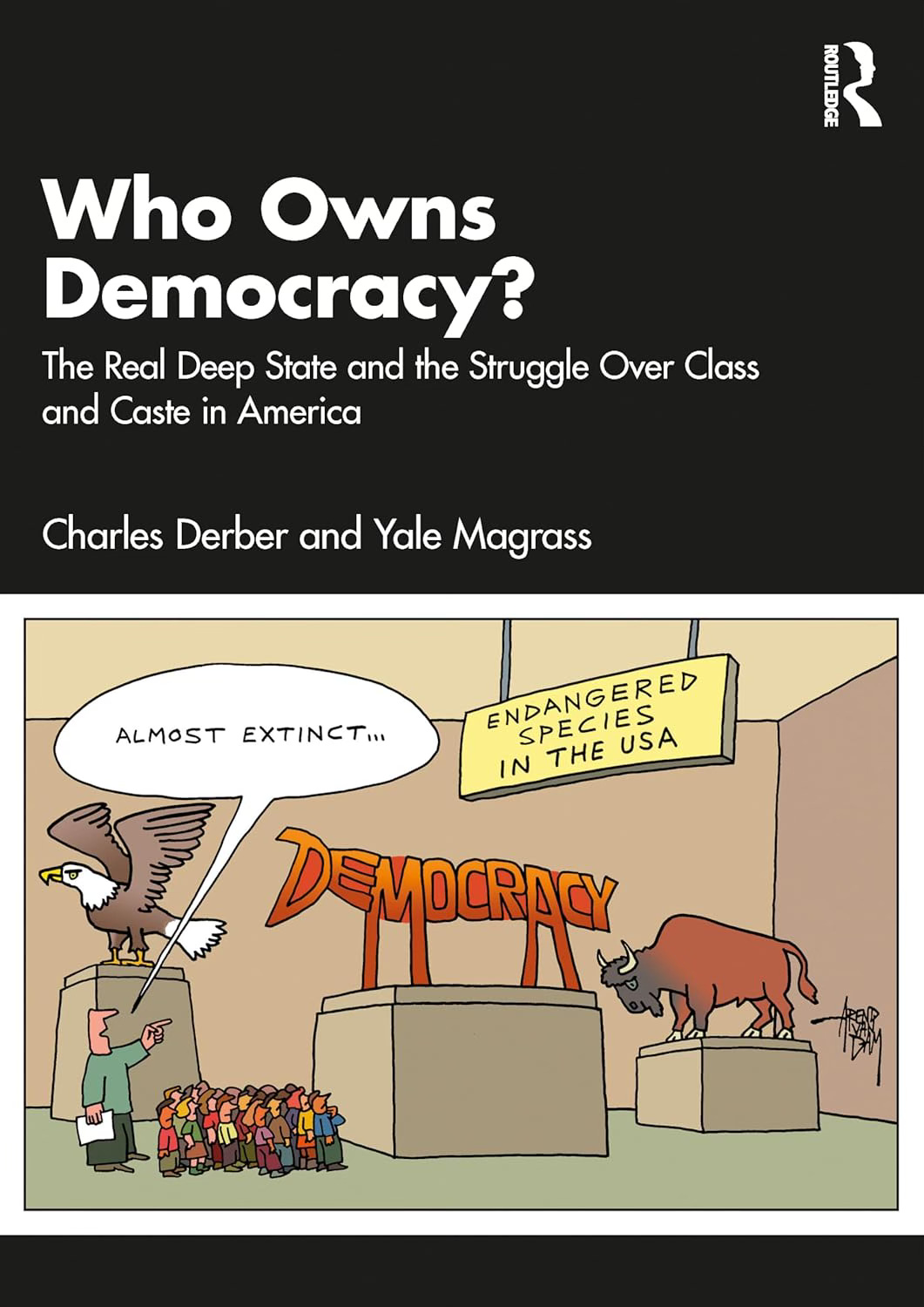
Charles Derber, a Professor of Sociology at Boston College and life-long activist has authored 28 books on topics such as politics, democracy, fascism, corporations, capitalism, climate change, war, culture wars, and social change. In this episode of the Influence Continuum, he helped us delve deeper into the historical dynamics of class and caste. His latest book, co-authored with Yale R. Magrass, Who Owns Democracy? The Real Deep State and the Struggle Over Class and Caste in America presents a candid discussion about the hard truths of power and who predominantly bears the burden or responsibility of the deep state.
Defining the Deep State
“Deep State” is a phrase that has been used in many media headlines and conversations at this time in history, sometimes inaccurately or to further inspire conspiracy theories. Charles, however, defined it from his research as “a state behind the state, or, in other words, a kind of ruling power, some sort of group that can exercise disproportionate control over the government itself and the country.” We also later discussed how tactical use of social media often highlights it, including foreign interference and information warfare. Per the press release for this latest book, the three legs of the deep state are explained as “a nexus of powerful corporate, military, and governmental elites, who undermine democracy to retain their wealth and power – sometimes overtly, but more often quietly.”
Charles noted that the view of a deep state is not particularly radical, but most Americans agree that there is a great deal of unelected influence in government. Additionally, people also understand that the powers of big money, racial privilege, and other factors play a significant role in whose voices are heard today. In Who Owns Democracy?, the authors strive to talk to readers about threats to our nation and ways to resist effectively.
Drivers of the Deep State in America Today
The book breaks down deep state politics into three levels: the corporate deep state, the military-industrial complex, and upper levels of civilian democracy, according to Charles. In the upper levels of civilian democracy, we see unelected influences on the political elite, those who speak directly into the ears of the elected. I reminded the listeners of my recent interview with Gareth Gore surrounding the undue influence of Opus Dei on top-level American politicians today.
Charles noted that his focus on deep state concerns rested within corporate influence on domestic and global policies. We discussed, however, that my focus of concern on deep state influence rested far more on foreign actors like Russia and China. Ultimately, we agreed that both foreign and domestic deep state actors were not leading our nation to a very safe place, with topics such as nuclear annihilation and climate catastrophe both always on our possible horizon.
Early America and the Deep State
We explored how the roots of the deep state in America trace back to a complex alliance between the northern mercantile (capitalist) states and the southern agrarian states reliant on slavery. This tension eventually erupted in the Civil War, followed by a reluctant reunion that solidified a new form of deep state by the early 20th century. During this period, powerful family dynasties such as the Rockefellers, Morgans, Carnegies, and other influential figures emerged as key players in shaping the nation’s economic and political landscapes, akin to the Koch family’s current influence.
Charles emphasized that echoes of the southern class and caste systems, characterized by racism and immigration fearmongering, still pervade contemporary American politics. He pointed out a concerning trend where, for the first time since the Civil War, Trump’s administration appears poised to actively implement aspects of this historical legacy, marking a disturbing resurgence of what we identify as American fascist tendencies.
Empowered and Evolved Through Struggle
Despite what he called its “hardwired problems,” Charles spoke of optimism in reviewing those times in history when the American public struggled to regain control and changed the course of their nation. He recalled such times as the civil rights movement, working people uniting, the suffragettes, and populist movements. America has a long history of expanding policies to support the broader populations more equitably. Ordinary people showed great success in organizing and understanding how to create new paradigms in governance that discourage deep-state actors from gaining authoritarian control.
Similarly, we reviewed times in American history where the government has acted with unbalanced dominance, creating destruction in other nations. We discussed what responsibility our nation must accept in creating global instabilities in this unbalanced time. However, as Charles noted, this can be an empowering lesson for the country, as we can learn to better operate with other nations in increasingly fair and equitable alliances. He reminisced about how Eleanor Roosevelt played a pivotal role in advancing the United Nations in its early years as chairperson of the Commission on Human Rights. Charles remarked that we want the United States to be integrated into the global community, not with authoritative leadership, but rather to do the hard work of building the alliances and building the international institutions that allow this to function.
Charles and I concluded our discussion by emphasizing the proximity of the election and the crucial importance of every vote. This election stands as one of the most significant in our lifetime. I also urged everyone to ensure they vote fully down the ballot, as every race shapes the future direction of our nation.
Resources:
Who Owns Democracy? | The Real Deep State and the Struggle Over Class (taylorfrancis.com)
Boston College: https://www.bc.edu/bc-web/schools/morrissey/departments/sociology/people/faculty-directory/charles-derber.html
So pleased your election 🗳️ interference had no effect on Trump and his landslide win