



Consider this paradox.
Jehovah’s Witnesses’ leadership and the Watch Tower Society1 tell members the end of the world is so close they shouldn’t bother with college or long-term plans, yet aggressively solicits wills, real estate, retirement accounts, and stock donations through sophisticated “charitable planning” programs.
Why?
This contradiction sits at the heart of a financial apparatus that has quietly accumulated billions in real estate sales alone, while leaving members and their families who might otherwise inherit their assets financially vulnerable.
An internal brochure obtained and analyzed below shows in great detail the extent of the financial assets being solicited and the mechanisms of undue influence used to obtain them.
Court records spanning decades document a pattern of successfully contested wills where elderly, isolated Witnesses left everything to the organization, sometimes after Jehovah’s Witness Elders prepared the documents themselves.
A Century of False Prophetic Deadlines
In reality, the Watch Tower’s financial leverage over members relies entirely on apocalyptic urgency. Originally, 1914 was supposed to bring “the complete overthrow of earth’s present rulership.” When World War I failed to become Armageddon, the organization retroactively claimed 1914 marked an “invisible” heavenly event.
Next came declarations that biblical patriarchs would resurrect in 1925, but the prediction proved false again.
The most damaging series of statements began in 1966, claiming doom for non-believers and predicting it would occur in 1975. Many Witnesses believed Armageddon was imminent and began proselytizing full-time, feeling a great responsibility to spread the word. Others postponed medical procedures, cashed in insurance funds, and quit their jobs. Meanwhile, official publications praised members “selling their homes and property” in preparation.2
After the 1975 prediction failed, membership declined rapidly. The Watchtower’s 1976 response blamed members, accusing them of failing to understand or misinterpreting the prediction.
Today, the current doctrine stretches the 1914 prophecy indefinitely. Two groups of “anointed” Witnesses whose lifespans “overlap” will see Armageddon, effectively extending the timeline potentially to the 2100s or beyond.
Education Discouraged, Donations Encouraged
Notably, the organization has consistently discouraged higher education. Governing Body member Anthony Morris III is on record as calling university professors threats who “will be trying to reshape the thinking of your child.”
The result of this teaching is that only 9% of Jehovah’s Witnesses hold undergraduate degrees, the lowest of any faith group measured by Pew Research, compared to a 30.4% national average.
This financial exploitation creates a cohort of members who forgo education and career advancement, then feel organizational pressure to donate those assets rather than leave them to potentially “apostate” family members.
The Watch Tower Society maintains no publicly accessible financial statements; however, partial visibility comes from property transactions, charity filings, and occasional IRS documents. Total assets controlled remain hard to pin down in the minutiae; however, they are most certainly in the billions of dollars.
Ironically, the H.M. Riley Trust trades stocks in ExxonMobil, Coca-Cola, tobacco, and Cardinal Health (a blood transfusion equipment supplier), companies whose products violate the JW doctrine. Crain’s New York Business estimated the organization saved $368 million in real estate taxes over 12 years on Brooklyn properties alone through religious exemption.
Certainly, someone with both financial education and literacy is making these smart investment choices.
Inside a Watch Tower Brochure
The 32-page brochure, obtained by Freedom of Mind and titled “Charitable Planning to Benefit Kingdom Service Worldwide,” presents itself as a helpful document for estate planning. However, make no mistake: it serves as an asset-solicitation device that reveals much about the organization’s financial priorities.

Much of the language exposes patterns designed to guide elderly members toward irrevocable financial commitments while maintaining plausible deniability about pressure tactics.
The brochure opens with a biblical command framed as a financial directive,

The document proceeds to immediately define what “valuable things” means and states,
“They give generously of their time, their talents, and their strength—all valuable things.”
Notice the rhetoric utilized here. Time and energy are equated with financial assets. Of course, leading with complementary examples of time, talent, and strength makes the forthcoming financial asks much more palatable.
The brochure then quickly adds, “Beyond giving of themselves in the preaching and teaching work, all are privileged to support it through monetary donations.”
Here, the word privileged, is used to reframe giving money as a spiritual honor rather than a personal financial decision.
Despite the century of failed predictions, the brochure continues, stating the mission is “all the more urgent and challenging.”
This urgency language appears alongside detailed explanations and instructions for irrevocable financial contracts, that is, financial decisions that cannot be reversed. The scope of asset solicitation is immense.
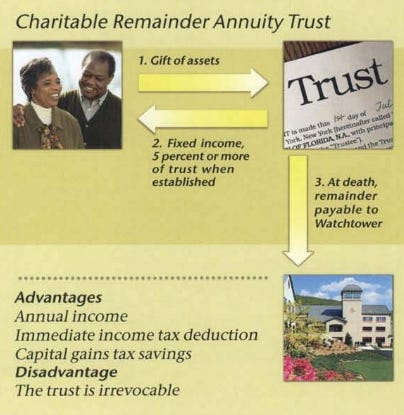
The brochure, again, 32 pages in length, provides explicit guidance for donating virtually every asset class a person or family might possess, including, but not limited to,
Cash donations
Stocks and bonds
Real estate
Jewelry, stamp or coin collections, and other tangible personal property
Bank accounts (“in trust”)
Retirement plans
Life insurance policies (naming Watchtower as beneficiary)
Personal residences and farms
Wills and living trusts (with specific bequest language provided)
Sidestepping the Courts
The brochure explicitly identifies elderly members as the appropriate audience for certain instruments.
For instance, the section on Gifts From Retirement Plans targets those “70 1/2 and older” who “can distribute up to $100,000 directly from an IRA to Watchtower.”
The brochure emphasizes the benefits of “avoid[ing] the expense, time, and uncertainties of probate (a legal process that validates a deceased person’s will) as a benefit.
The “Totten trust” arrangement is explicitly designed to transfer assets “directly” to Watchtower at death, preventing “the delays and uncertainties typical of probate.”
What the brochure does not mention, is that this also means bypassing the legal process that might allow family members to contest improper transfers. Perhaps quite revealing is the brochure’s carefully worded disclaimer,
“It is neither the intention nor the desire of the Charitable Planning Office to solicit donations. Rather, we merely provide information to those who inquire about estate planning in which the organization may be involved.”
This appears on page 8, after 7 pages establishing spiritual duty, urgency, privilege, and the many asset classes available for transfer.
I also spoke with an ex-JW who managed property for the organization, on background, about his experiences, as I sought to understand the effects of this financial solicitation.
“I was given a close view into how estate decisions sometimes affected families in painful and lasting ways,” he said. “In practice, it often meant the quiet severing of generational support that families might otherwise have relied upon.”
He, too, had noticed the glaring contradiction. “One case in my own congregation has never left me”, he said. “What struck me most was… an institution that teaches the insignificance of material wealth nonetheless retained and utilized that wealth.”
As for the scale of the solicitation, the description was unequivocal.
“This was not an isolated incident. Variations of this pattern, repeated globally over decades, likely amount to hundreds of millions of dollars redirected away from families and into institutional holdings.”
Financial Exploitation of Elderly Witnesses
This pattern of financial extraction from elderly Jehovah’s Witnesses meets the legal criteria for undue influence as defined by both statute and scholarly models. This helps explain why court cases challenging Watch Tower bequests have repeatedly succeeded.
California law defines undue influence as “excessive persuasion that causes another person to act or refrain from acting by overcoming that person’s free will and results in inequity.” The law specifies four factors, and the Watchtower’s systematic approach to soliciting elderly donors exhibits all four.
1. Vulnerability of the Victim
The law outlines indicators of vulnerability as “incapacity, illness, disability, injury, age, education, impaired cognitive function, emotional distress, isolation, or dependency.”
Older Witnesses embody many of these indicators. The brochure explicitly targets members “70 1/2 and older” for retirement fund transfers. As noted above, Witnesses are discouraged from spending time on formal education, given the impending Armageddon.
Members who maintain relationships with disfellowshipped family face organizational sanctions, and, as a result, may have no one outside the organization to consult about financial decisions. Since friendships and community all exist within the congregation, openly questioning Watch Tower-encouraged financial directives risks relationships that constitute a member’s entire social world.
After all, a “good” Jehovah’s Witness believes (or performs the belief) that Armageddon is imminent, family members who have left are under Satan’s influence, and that failing to support “Kingdom interests” dishonors Jehovah.
2. The Influencer’s Apparent Authority
The law recognizes “spiritual adviser” as a position of apparent authority. Here, we can certainly count The Watch Tower and its officials as spiritual advisors.
Their “Governing Body” claims to be God’s sole channel of communication on earth. The Charitable Planning Office operates under this divine authority. When a “brother” from headquarters calls an elderly member about their estate, he carries spiritual weight to a Witness that no ordinary financial advisor possesses.
Remember the opening excerpt in large text at the beginning of the brochure.
“Honor Jehovah with your valuable things.”
It’s a command from God. This is no mere suggestion.
3. Actions or Tactics Used
California law specifies that evidence of improper tactics includes:
“Controlling... the victim’s interactions with others, access to information... Use of affection, intimidation, or coercion. Initiation of changes in personal or property rights…”
The many court cases document exactly these patterns:
Among many such cases, one example is the estate of Louis Hee. It was found that an Elder drafted the will and secretly sent it to JW headquarters. A Florida judge found that it was “not the free expression of the decedent.”
4. Equity of the Result
Finally, the law asks whether the result reflects “any divergence from the victim’s prior intent or course of conduct.”
When older adults leave their entire worth to an organization that tells them Armageddon is imminent and the funds are needed to save the world, the inequity is evident.
Courts have recognized this pattern repeatedly by invalidating wills. The challenge is that many bequests never reach court, family members may not know about changed wills until after death, and the reality is that contested probate is expensive.
The Watchtower’s “charitable planning” program represents a particularly egregious form of financial undue influence. By leveraging decades of apocalyptic conditioning, older adults are systemically stripped of assets through claims of divine authority.
This pattern is heavily documented. What’s needed is awareness that this form of systematic financial exploitation continues, operating within a conveniently tax-free bubble.
Shunning isolates members from natural family heirs
One angle to consider is the organization’s disfellowshipping policy, which results in complete shunning by family and friends. This creates conditions conducive to disinheritance and prevents any outside influence providing alternative perspectives.
Essentially, a Witness must, and will, be surrounded by other Witnesses — or face being disfellowshipped themselves. And who, then, will question the official narrative of bequeathing your estate to the Watch Tower, even if one personally questions the decision?
Official instructions prohibit even greeting disfellowshipped family members,
“Despite our pain of heart, we must avoid normal contact with a disfellowshipped family member by telephone, text messages, letters, e-mails, or social media” 3
Shunning itself performs a financial function by discouraging members from staying connected to “worldly” networks. It encourages them to remain within the congregation’s influence, dependent on the strong, insular social structure that shunning would destroy. And most concerning, it frames leaving assets to non-Witness family as enabling apostasy.
The members most susceptible to this solicitation have spent decades in an environment that discouraged outside relationships while teaching that family members who leave are spiritually dangerous. One study even found that ex-Witnesses reported that “saving for the future or making material gains [was] seen as heresy as that would imply one did not believe Armageddon would occur.” 4
How Long Is the World Going to End For?
Altogether, history tells a story of an organization that has accumulated billions while preaching the imminence of Armageddon for over a century.
In today’s Witness-sphere, the current “overlapping generations” prediction provides a convenient, indefinite flux state while simultaneously maintaining enough urgency to facilitate a structured financial scheme.
For families who have lost relatives to shunning (and may lose inheritances to the organization), this paradox is both painful and personal. For investigators and regulators, the paradox begs the question of whether a religious exemption should shield financial practices that, in any other context, would trigger scrutiny for elder abuse.
At the beginning of this article, I asked a simple, open-ended one-word question.
Seemingly, the Watch Tower provides no answer.
Further Reading
More on the topic of the Jehovah’s Witnesses


1 A note on terminology: “Jehovah’s Witnesses (JW)” or “Witness(es)” refers to the members worldwide who practice this faith. “The Watch Tower” or “Watchtower” refers to the legal entities that govern the organization, publish its literature, and control its assets. Other names are in use; however, these names are used here for clarity.
2 How Are You Using Your Life? - Kingdom Ministry—1974
3 The Truth Brings, “Not Peace, But a Sword” - The Watchtower Announcing Jehovah’s Kingdom (Study)—2017
4 What Happens to Those Who Exit Jehovah’s Witnesses: An Investigation of the Impact of Shunning, Rosie Luther
The claim to be God’s sole channel of communication on earth by someone who identifies as a Christian is a manifestation of the “cognitive dissonance” phenomenon in that Jesus makes exactly the opposite claim (see Matthew 22:40).
This is an interesting edition to me because I know next to nothing about the Jehovah Witness cult (I know enough to know that they are not a real religion), but they knocked on my door this past summer, and we had a long discussion. I tried and failed to impart my understanding of the Gospel message, and I failed to understand the motive underlying their words. Now it all makes sense.
I claim to be one of God’s roughly eight billion (still walking and talking) channels of communication. In other words, we all need to help each other see the truth that will set us free (John 8:32). I make a habit of following Richard Rohr’s example by adding, “but first it will make you miserable.” Ain’t that the truth?
My mission is to remove the current misinterpretation of Benjamin Libet’s famous experiment from the field of psychology’s body of knowledge by replacing it with a scientifically valid interpretation. The bad news is that it is hard. The good news is that it is simple.
I published an essay (E16) on January 30 in which the message is the same as my previous essay (E15), but I put a lot of effort into making the concept easier to understand.
The link is here: https://jamesrcarey.substack.com/p/solving-the-meta-problem-e16?r=2nayrh