


January 6th, 2021, is a day etched in the collective memory of Americans, no matter their political views. The violent attack on the United States Capitol, an attempt to overthrow the results of a democratic election towards support for Donald Trump, left several dead and many more injured. Trump later pardoned nearly 1500 individuals including violent offenders involved in the attempted insurrection on his first day back in office in recent weeks, further underscoring his role in the attack on the nation's core institutions.
For those on the ground that day defending the Capitol, working inside the building, or covering the events for news outlets, post-traumatic stress is undeniable. The situation was chaotic, life-threatening, and fueled by the violent anger of those carrying Trump’s banners. Kate Woodsome, at the time a journalist for The Washington Post, was there during the attack. She recalled being handed a bulletproof vest, helmet, and mask, preparing for what would soon become an intensely hostile environment. Confronted by an angry mob, she was blamed simply for being part of the press. During our conversation, she described how she managed to de-escalate the situation with a quick, calculated response. Yet, the impact of the day left deep scars. “I experienced a very significant trauma from that interaction, from the entire day, and from the response to the trauma afterwards, institutionally,” she said.
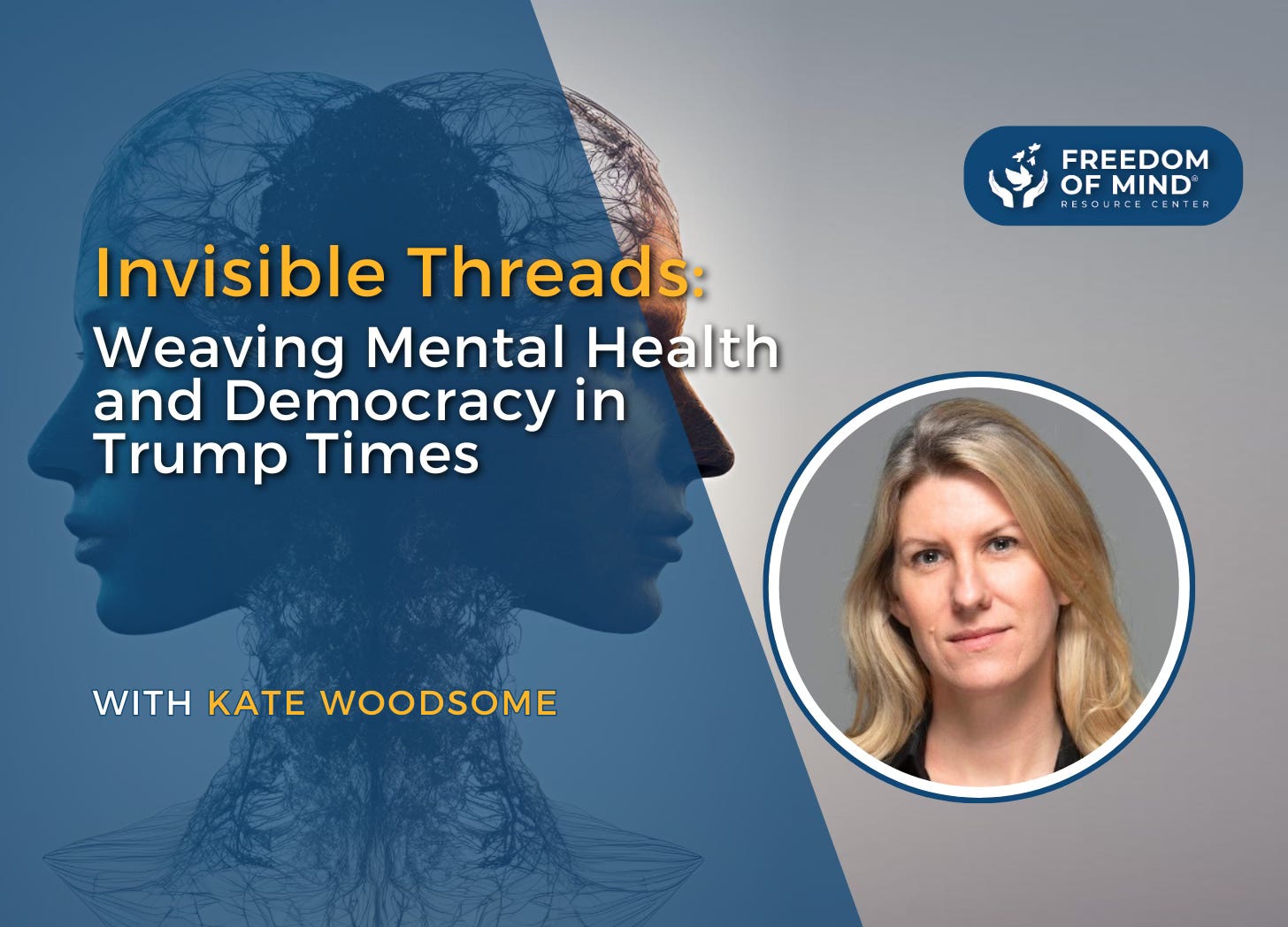
In this episode of Cult Conversations: the Influence Continuum, we spoke with Woodsome, who is the founder of The Invisible Threads Project, which studies the relationship between mental health and democracy. She was part of The Washington Post team who won a Pulitzer Prize for Public Service in coverage of the January 6th Capitol attack. She is also a fellow with Georgetown University’s research and design unit, The Red House, which focuses on transforming cycles of trauma into healing and well-being. Woodsome has also been honored with the Ben Bradlee Award for Courage in Journalism, an Edward R. Murrow Award, and honors from the White House News Photographers Association in response to her work as an editor, journalist, and producer.
Trauma and the Road to Recovery
Woodsome left The Washington Post in 2023, stating in her biography that she could no longer normalize the trauma, burnout, and moral injury pervasive in the industry. She noted in our discussion that her childhood contained abuse and trauma that the Capitol attack would reawaken. Once able to rely on being a workaholic who pushed through, she decided to take a step back and focus on healing and the rediscovery of self-identity and self-worth. This eventually allowed her to return to focus on social movements. She covered The People’s March on January 18th, 2025, and then went on to speak with Trump supporters outside of the Capital One Arena in Washington, D.C., following his inauguration.
I noted that I thought she made the right choice to work on herself and to take that triggering moment and turn it into a healing opportunity for herself and her soul. We discussed how working on mental health and healing from adversity was a strength. We now know that some of the most resilient people process through discomfort with a network of others.
Compassion as an Opening for Change
We talked about the recent election of Trump and the support for that process from the Heritage Foundation, Opus Dei implications, and Project 2025. I recalled how when I was in the Moonies, and it was my father’s compassion and tears that opened my mind to the realization that I had been brainwashed, which gave me the ability to reconnect with my authentic self. That, combined with realizing that Moon lied to American politicians about his feelings concerning youth being “brainwashed,” allowed me to have my first critical thought in two and a half years. “Then he can’t be a man of God because God is a God of truth according to the principles of the group,” I recalled. I had had many direct experiences with Sun Myung Moon, often enough to know he was blatantly lying. This opened the possibility of rational thinking and reconnection with the authentic self.
Woodsome agreed and noted her experiences with Trump supporters who “weigh the cost against the benefits.” She said that in listening to his voters, concerns about rising costs in a democracy were at the forefront of some people’s minds. She discussed how moral injury, particularly amongst members of the U.S. military, maybe a driver towards moving in ways that conflict with a base value system. She then stated that Trump’s followers may already be starting to see this conflict, however, as many did not agree with the violence of the Capitol attack on January 6th. Thus, when Trump blanket pardoned or commuted the sentences of some of the worst offenders, this was “an immediate affront to the values of even some of his core supporters,” she noted.
Opportunities for Critical Thought in Fringe Members
Woodsome and I discussed family and individual systems in the realm of mental health and how these ideas might relate to our current societal or government structures and modern complexities. We also talked about how living in a digital age with overwhelming addiction to smartphones might factor into the problem. We discussed ways to opt out of the constant stream of data to maintain or heal mental health.
“What I’m really trying to focus on is civil discourse and looking at the underlying roots of our problems, as opposed to their ugly symptoms,” said Woodsome. In Chapter 9 of my book, The Cult of Trump, I recommended being warm, not attacking followers, and congratulating them as appropriate. We discussed looking for opportunities with family and friends to find common ground and common beliefs. We also discussed empowering people to think for themselves. Not everyone is as radicalized, and fringe members may not fully understand the beliefs and practices of the core community.
As we were wrapping up the conversation, Woodsome reminded people to “begin to tune into your gut”. She pushed to have more awareness of your body and listen to what it’s telling you. “This can even begin with, ‘Do I want soup, or do I want a sandwich?’” She then turned this tuning into saying a broader ‘no’ to what you don’t want and ‘yes’ to what you do want to gain skills around understanding self-censoring. I agreed and noted that the cure to dissociative issues is to be in your body. In closing, I also reminded my listeners to build community, make friends, go dancing, listen to music, and play with puppies. “Love is stronger than fear. Love is stronger than mind control,” I concluded.
Resources:
Substack: @kwoodsome // katewoodsome.substack.com
Instagram: @kwoodsome
LinkedIn: linkedin.com/in/katewoodsome/
Website: katewoodsome.com
Crimes of Big Money in Politics
🔸Endless war in every country for endless profit
🔸Endless destruction of the environment for endless profit
🔸Endlessly pit society against itself to hide in plain sight for endless profit
"Consequences of Capitalism", Noam Chomsky, Preface
https://open.substack.com/pub/simonwdc?utm_source=share&utm_medium=android&r=280c3q